



What is professional co-development?
Professional co-development is a group learning method in which peers help each other resolve real professional situations. In each session, one participant, the client, presents a concern, a problem, or a project; the others, the consultants, help them through their questions, reactions, and suggestions; a facilitator guarantees the framework and the process. Everyone learns: the client makes progress on their situation, while the consultants enrich themselves by helping.
The method was formalized by Adrien Payette and Claude Champagne, two researcher-teachers from Quebec, in their reference book Le groupe de codéveloppement professionnel (1997). It is based on a simple conviction: we learn better from reflected experience than from theory, and the intelligence of a peer group exceeds that of each of its members. Widely spread in France in the 2000s, it is today one of the most widely used systems to support managers, executives, trainers, HR, or project managers.
What distinguishes co-development from a simple discussion meeting is its rigorous structure: six time-boxed steps, clearly distributed roles, and a consultation phase during which the client remains silent and listens. This discipline is not a mere formality: it prevents the group from falling into hasty advice or debate, and it produces lasting learnings.
Co-development, codev, co-development: which term to use?
All three refer to the same practice. "Professional co-development" is the original name, "codev" its common abbreviation in companies, and "co-development" an alternative spelling. Be careful not to confuse it with co-development in the sense of cooperation between countries, or software co-development: here, it is exclusively about professional development by peers.
What co-development is not
It is neither training (no top-down content), nor group therapy (we deal with the professional, in action), nor brainstorming (the process is framed, not free), nor a problem-solving meeting (the client remains the sole decision-maker of what they do with the contributions). To transmit a skill to a group, the right format is the virtual classroom; to meet and decide, a videoconference. We detail the differences in the comparison below.
The key benchmarks of a co-development group
The orders of magnitude that make a codev work.
Participants per group, plus the facilitator. Below this, there is not enough diversity of perspectives; beyond it, the consultation drags on and the quieter members stay silent.
The duration of a session to treat a situation while respecting the six steps. Remotely, 1.5 to 2 hours with a real break.
Sessions, usually monthly, so that a complete cycle allows each member to be the client at least once and for trust to settle in.
These figures are not dogmas but safeguards. Co-development produces its effects over time: it is the repetition of sessions, with the same group, that builds the trust necessary to expose a real difficulty, and that transforms individual reflexes into a collective culture. A "one-shot" codev is an interesting workshop; a codev cycle is a development program.
Client, consultants, facilitator: the 3 roles of co-development
Codev works because everyone holds a specific role, and only one at a time.
The client
They bring a real, current situation over which they have some margin of action. They present it, answer questions, formulate their contract, then listen without answering during the consultation. In the end, they decide alone what they retain and commit to an action plan.
The consultants
The other members of the group. They ask questions to understand, then offer the client their reactions, hypotheses, experiences, and suggestions, without trying to be right. They learn as much as the client: every situation presented resonates with their own.
The facilitator
Guarantor of the framework and process. They remind the rules, keep the steps and time, distribute the speaking time, block premature advice, and protect the client. They do not provide substantive solutions: their value lies in the quality of the process, not their business expertise.
Role rotation, the engine of learning
From one session to the next, the client changes: every member of the group is, in turn, the one who presents and the one who helps. It is this alternation that makes co-development a school of posture: learning to listen without reacting, to question without guiding, to suggest without imposing, and not just a problem-solving method.
The 6 steps of a co-development session
The reference flow according to Payette and Champagne. Durations are given for a 2.5-hour session.
Before the six steps, an opening phase: the group members meet, the client from the previous session gives an update on their action plan, then the group chooses the topic of the day: everyone proposes a situation, the group selects the one to be addressed, and its author becomes the client. Some facilitators count this opening as a step in its own right; we treat it as the preamble to the method itself.
Presentation of the situation 10 to 15 min
The client presents their concern, problem, or project: the context, the actors, what they have already tried, what is blocking them. The consultants listen in silence and take notes. The facilitator ensures that no one interrupts.
Clarification 15 to 20 min
The consultants ask informational questions ("how many people?", "since when?") and understanding questions ("what weighs on you the most?"). No advice, no hypotheses disguised as questions: this is the step the facilitator monitors the most.
Consultation contract 5 to 10 min
The client formulates in one sentence what they expect from the group: "I would like you to help me to...". The group reformulates if necessary until a clear request is obtained. This contract, written down and visible to all, frames everything that follows.
Consultation 30 to 45 min
The consultants share freely: reactions, feelings, hypotheses, similar experiences, suggestions. The client listens, takes notes, and does not respond, neither to justify nor to dismiss. It is this silence that allows them to receive what they wouldn't have heard otherwise.
Synthesis and action plan 15 to 20 min
The client speaks again: what they retain, what they discard, and most importantly, what they are going to do, when, and with whom. The group can help them make the plan concrete and dated. At the next session, a quick update on the actions taken opens the session.
Learnings and evaluation 10 to 15 min
Round table: everyone, client and consultants, expresses what they learned on the substance (the situation) and on the process (their own posture, the functioning of the group). The facilitator closes, reminds everyone of the confidentiality, and announces the client for the next session.
Co-development, coaching, mentoring, training: what are the differences?
Four professional development formats that are often confused, four distinct logics.
| Criteria | Co-development | Coaching | Mentoring | Training / Virtual classroom |
|---|---|---|---|---|
| Setup | Peer group (5 to 8) + facilitator | One coach, one coachee | One senior, one junior | One trainer, one group |
| Who provides content | The peers, based on their experience | The coachee, guided by the coach's questions | The mentor, by transmission | The trainer, via a learning scenario |
| Relationship | Horizontal | Individual support | Vertical, from experience to the next generation | Top-down then participative |
| Material worked on | Real and current situations of the participants | Goals and functioning of the coachee | Career path and business skills | Skills targeted by a program |
| Who learns | The whole group, simultaneously | The coachee | The mentee (and often the mentor) | The learners |
| Typical duration | Cycle of 6 to 12 sessions of 2 to 3 hrs | 6 to 12 sessions of 1 to 2 hrs | 6 to 18 months | From 1.5 hours to several days |
| Ideal for | Managers, trainers, experts facing complex situations | Transition, new role, strong individual challenge | Onboarding, career development | Acquiring a common foundation of skills |
Comparison of main professional development programs
Co-development vs coaching: collective vs individual
Coaching supports one person; co-development puts a group to work. In codev, no one "coaches": peers offer their perspectives, the facilitator holds the framework, and the client decides. The result is often complementary: many organizations offer coaching for a strong individual challenge, and co-development to build a culture of mutual aid among managers.
Co-development vs training: emergence vs transmission
Training, whether in person or in a virtual classroom, transmits predefined skills. Co-development has no curriculum: the content emerges from the situations brought forward. The duo works particularly well: a virtual classroom to acquire a foundation (for example, management fundamentals), then a co-development cycle to anchor it in everyone's real-life situations.
Facilitating remote co-development: what changes, what stays the same
Co-development was long practiced exclusively in person, around a table. Since 2020, the majority of cycles take place entirely or partially online, and the format often benefits from it: multi-site groups become possible, attendance improves, and sessions fit more easily into schedules. This is provided that four requirements are met—which standard videoconferencing does not handle well.
A tangible confidentiality framework
The client must be certain that their situation will not leave the group. Online, this requires a closed space, reserved for the group, with no passing participants, and a ritual to remind everyone of the framework at the opening of each session.
Visible and fair speaking time
In a grid of thumbnails, you don't know who has spoken or who is waiting their turn. A space where each participant has an identifiable place and where the facilitator can grant the floor makes the consultation clear and prevents two voices from dominating.
A shared medium for the contract and action plan
The consultation contract must be written down and visible to all throughout the consultation; the action plan must be formalized before closing. A collaborative note on the table, without switching windows, prevents distraction.
A stable space from one session to the next
A codev cycle lives for 6 to 12 months. Returning to the same place, finding the outputs from previous sessions, and tracking action plans creates the continuity that gives the program its strength.
What does not change: the method itself. The six steps, the roles, the client's silence during the consultation remain strictly identical. The only common adaptation concerns the duration, 1.5 to 2 hours with a break rather than 3 straight hours, and the group size, where the tendency is to aim for 6 participants to keep the consultation dense.
Glowbl, the collaborative space designed for online co-development
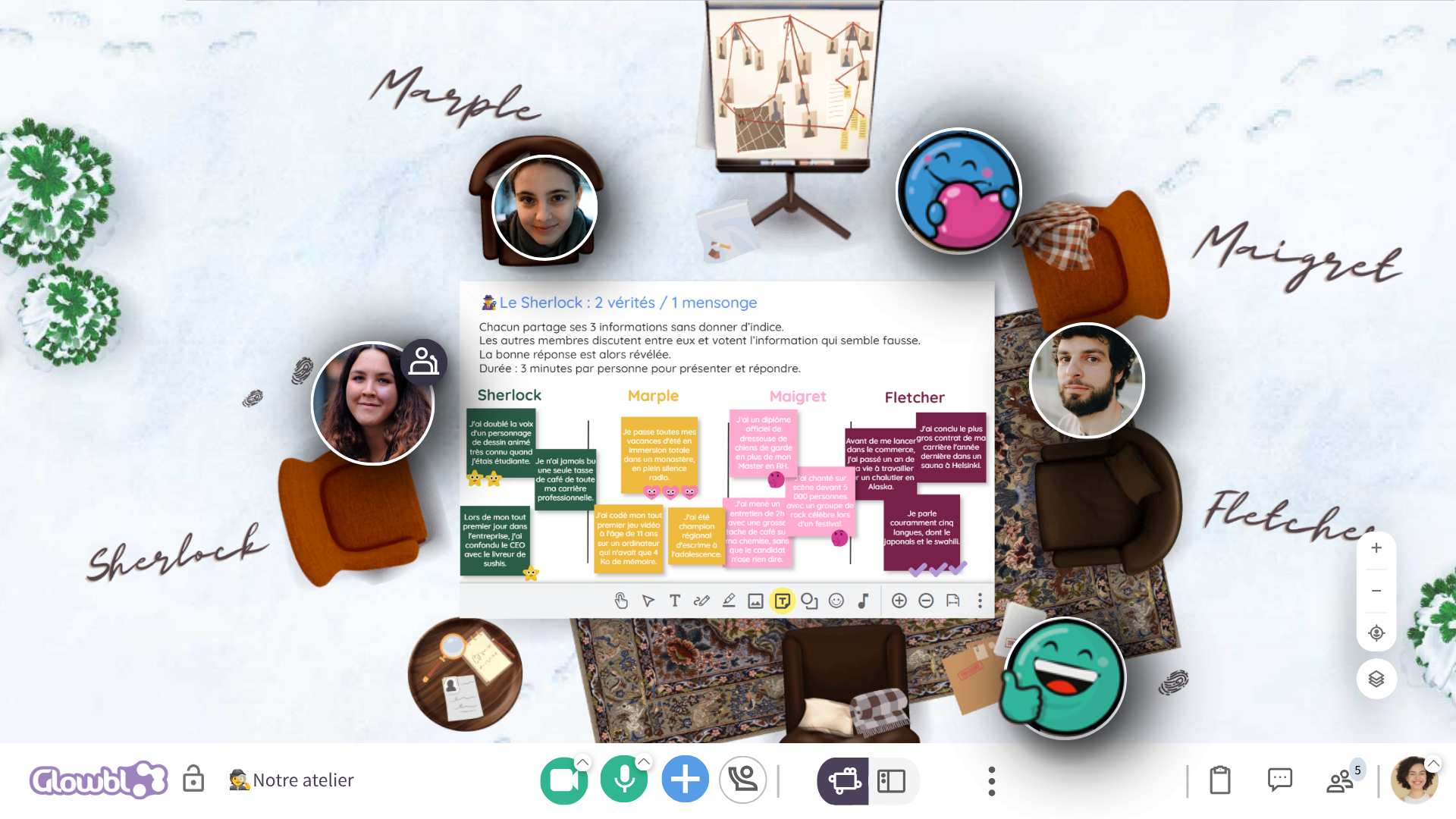
Glowbl is a French collaborative platform published in Lyon since 2011. Instead of a camera grid, it provides a visual space with work tables where everyone moves their bubble: exactly the room a codev group needs.
A place of their own, closed and recognizable
The space is permanent and customizable: colors, logo, group name. Members identify it as their own codev room, only they have access to it, and they meet there from one session to the next. It makes the confidentiality framework visible.
- Space reserved for the group, customized with its colors
- One table per group of 5 to 8 participants
- Multiple groups in parallel within the same space; the facilitator sees who is where and can join a table in one click
- Common plenary area for opening and closing
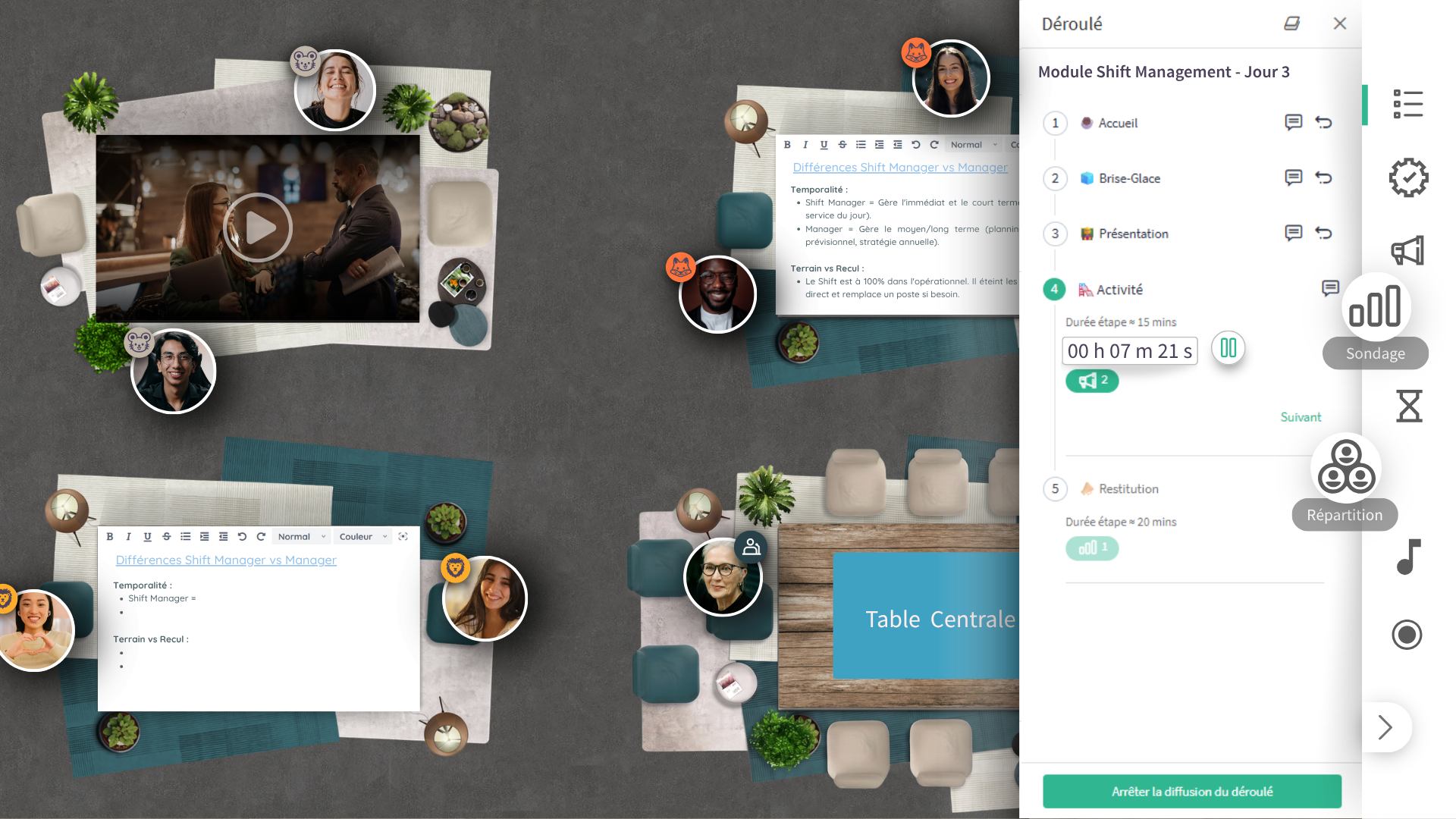
The six steps equipped, without leaving the window
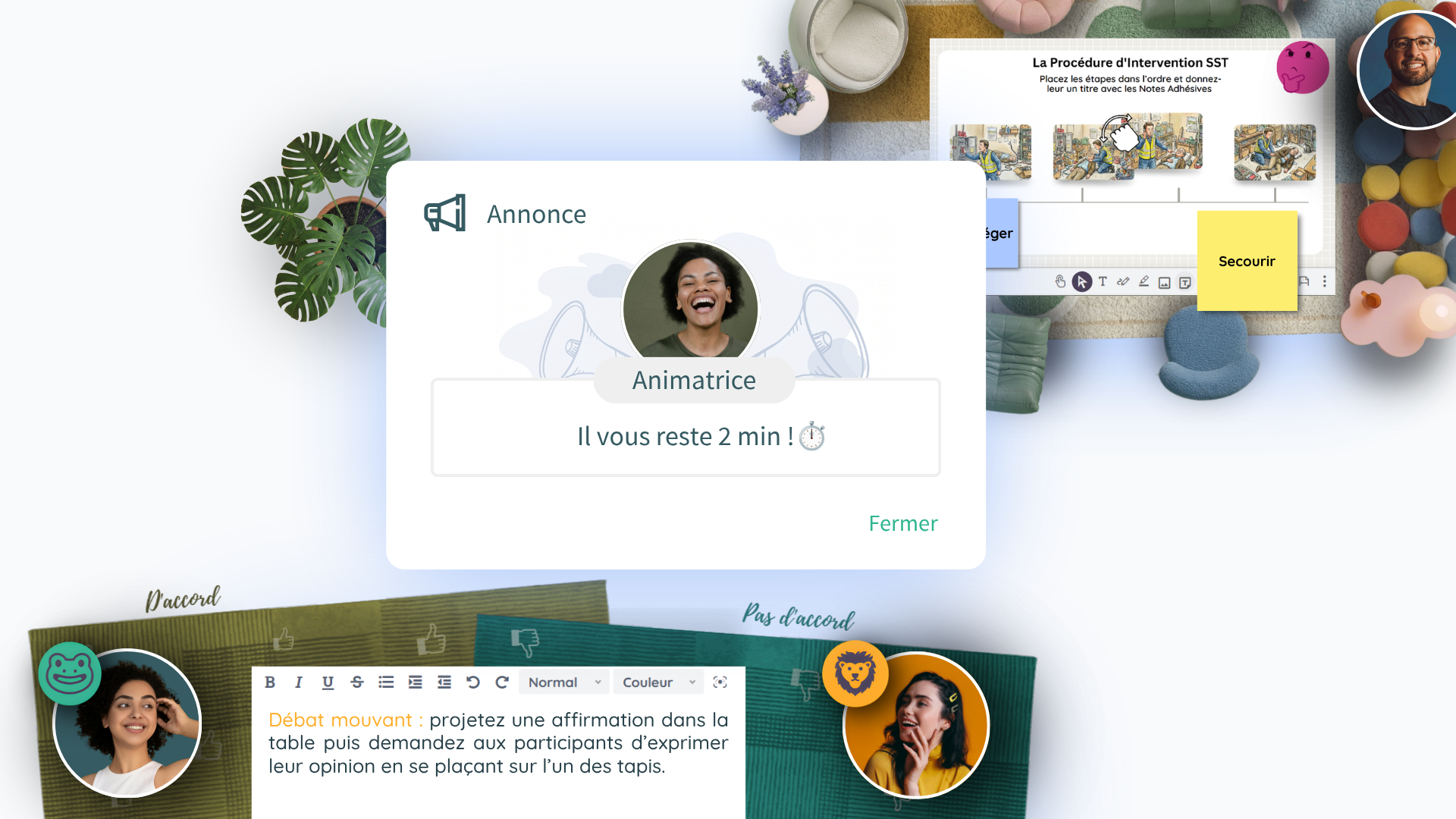
The facilitator has a pre-programmed, timed session Flow, which they launch step by step. The contract is written in the table's collaborative note, visible to all during the consultation; everyone takes personal notes; the action plan is formalized before closing.
- Timed flow: the six steps and their durations are launched with a single click
- Collaborative note on the table for the contract and action plan
- Personal notes for each consultant during the presentation
- Express polling for the learnings round or choosing the next client
A space that lives throughout the cycle
The session ends, but the space remains. Between two sessions, each participant can log in asynchronously to review the action plan, consult resources shared on the tables, or drop off a document for the next session.
- Persistent space accessible between sessions, both synchronously and asynchronously
- History of contracts and action plans is preserved
- One-click access from the browser, with no installation
- French publisher, GDPR compliant, European hosting
10 golden rules for facilitating a co-development session
The reflexes that make the difference between a thriving group and one that runs out of steam.
Set the framework at every session
Confidentiality, kindness, non-judgment, commitment to be present: recalled in two minutes at the opening, they never get old.
Choose "hot" situations
Real, current, and on which the client can act. A solved or out-of-reach problem produces nothing.
Block disguised advice
"Have you thought about...?" is not a clarification question. The facilitator points this out with a smile, systematically.
Write the contract, keep it visible
One sentence, displayed throughout the consultation. It's the thread that keeps the group from drifting to another topic.
Keep the time for each step
A timer visible to everyone, announced, and respected. The strictness of time liberates the spontaneity of the content.
Protect the client's silence
During the consultation, the client does not argue. It's uncomfortable, and that is precisely what helps them move forward.
Give the floor to the quiet ones
The most useful insights often come from those who speak the least. The facilitator calls on them by name.
Demand a dated action plan
"I'll think about it" is not an action. Who, what, when: three answers needed before closing.
Open by following up on actions
Every session begins with quick feedback from the previous client. This is what gives weight to the commitments.
Rotate facilitation
Once the group is mature, entrusting the facilitation to a member in turn develops this competency throughout the organization.
Want to test all this?
Create a space with several work tables and invite your codev group with a simple link.
Discovery Offer →Co-development in companies and training organizations
Where the method produces the most value.
Manager codev
The historical use case: managers of the same level, from different entities, who work on their team, tension, or decision situations. Often as an extension of a management program.
Trainer and facilitator codev
For training organizations: advancing trainers' postures in difficult pedagogical situations, and anchoring a common facilitation culture.
Expert and referent communities
Project managers, HR, sales reps, business referents: codev durably animates a network of dispersed peers, with a space that lives between sessions.
Onboarding and new role support
New managers or executives gathered in peer groups during their first few months: a collective safety net, less expensive than generalized individual coaching.
Transformation and change management
Making those driving change in the field work together, based on their real situations of resistance, arbitration, or communication.
As a complement to a virtual classroom
A foundation acquired in a virtual classroom, then a codev cycle to anchor it in reality: the most effective duo to turn training into a change in practices.
What those who facilitate remotely with Glowbl say
"Glowbl is the solution that comes closest to an in-person experience when facilitating remotely."
Head of Design & Build, L&D Center France · Capgemini
"When using Glowbl, something happens. There is life. Participants play with their bubble, move around, interact."
Project Manager, Skills Axis · SIG
"With Glowbl, we went from 138 slides to 20 on the hygiene training module."
Pedagogical Manager · Burger King