
The Benefits of Shared Knowledge
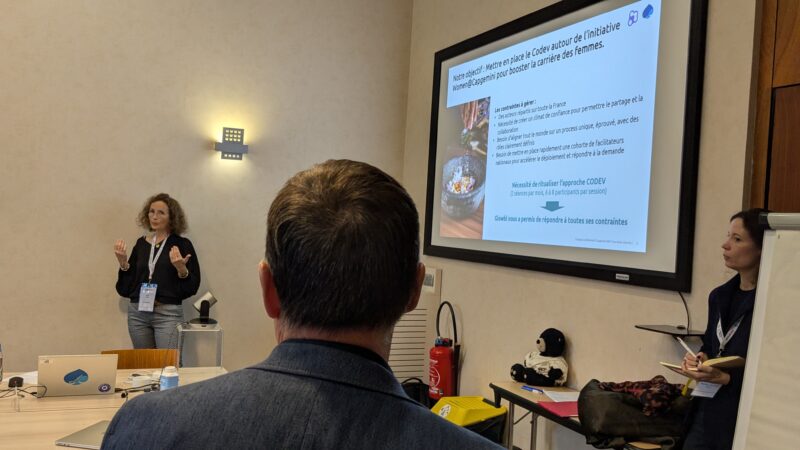
Did you know that 90 % of a company’s knowledge already exists internally, often in tacit form? This knowledge, essential to every individual, is a cornerstone of collective performance. At Capgemini, this belief has led to a genuine transformation in learning by fully embracing peer-to-peer learning as a strategic pillar.
Peer learning is a powerful performance driver with well-documented advantages. According to a Harvard Business Review study, peer learning:
- Unlocks tacit knowledge.
- Values internal experts.
- Speeds up learning by combining time and focus.
- Makes contextualization easier through direct exchange.
- Reduces training costs while fostering a culture of sharing.

Forms of Peer Learning
Peer learning is based on a simple idea: everyone has knowledge or experience that can help others. This idea takes multiple forms:
- One-to-Many: An expert or colleague shares experience or practices with a group—offering practical insights that can be implemented immediately.
- Many-to-Many: Collective intelligence workshops where participants contribute individually, with the richness coming from diverse perspectives.
- One-to-One: Individual coaching and mentoring.
However, peer learning only works effectively if two essential conditions are met: limiting beliefs must be overcome, and a climate of trust must be established.
Overcoming Limiting Beliefs
Many people self-censor and hesitate to share their knowledge. Typical thoughts include: “I’m not expert enough,” “My experience isn’t valuable,” or “I have nothing new to contribute.” In reality, the value of a discussion comes from both successes and failures. Sharing imperfect experiences—even those outside professional life—enriches the group. At Capgemini, every contribution is valued and recognized.

Creating a Climate of Trust
The second key pillar is creating an environment where collaborators feel free to speak without fear of judgment or evaluation. Knowledge sharing should not be seen as a performance assessment, but as a benevolent co-construction moment.
Ensuring Effective Peer Learning Sessions
For peer learning sessions to be truly impactful, several best practices should be followed:
- Structure the exchanges:
- Clear objective: Each session must have a specific goal—whether it’s solving a problem or exchanging best practices.
- Defined stages: A structured flow helps organize ideas, focus thinking, and prevent digressions.
- Defined roles: Assign roles such as facilitator (guides the exchange), a “client” with a problem, and participants who contribute.
- Time constraints: Each stage has a time limit to maintain momentum.
- Produce a real-time deliverable: Discussions should lead to a tangible result—a collaborative document that synthesizes ideas, solutions, or best practices. This deliverable provides a reference after the session.
- Capitalize on and share the deliverable: The outcome should be stored on an accessible platform so that learning endures. This also highlights contributors’ work and promotes ongoing knowledge sharing.
Towards a Sustainable Learning Culture with Glowbl
Glowbl has transformed how Capgemini runs its peer learning sessions by offering:
- Immersive, engaging workshops: Glowbl enables remote peer exchange workshops while maintaining an experience close to in-person meetings. The platform’s immersive, friendly environment simulates a real meeting room where every participant feels present. Table layouts are customizable to workshop needs, and facilitator seats are clearly identified to reinforce roles. Moving away from conventional tools like Teams creates a more relaxed, engaged atmosphere.
- Structured facilitation tools: Glowbl’s facilitation features guide sessions step by step—helping facilitators meet their objectives and respect time constraints. This ensures consistency across sessions and scales the method to large groups and new facilitators.
- Effective collaborative tools: Glowbl’s collaborative note feature centralizes participants’ contributions in real time. This shared document becomes the foundation for effective knowledge capture and can be used immediately.
- Automatic session summaries: At the end of each session, Glowbl automatically generates a summary, simplifying synthesis work.
We warmly thank Capgemini, Nelly Haye & Bertrand Cauwet for sharing their testimonial.
✨ Want to try Glowbl?
Discover a new way to collaborate and deliver online training—simply and effectively.
🚀 Discover Glowbl